
How content-addressed storage, immutable state, and explicit lifecycle events can make digital credentials easier to verify
Digital Credentials Have a Verification Problem
Digital certificates are easy to distribute. Verification becomes harder once a document leaves the system that issued it. A verifier may receive a PDF with no direct way to determine whether it is the exact file originally issued, whether the metadata associated with it has changed, or whether the intended recipient ever accepted the credential.
One way to address this problem is to separate the credential into layers. Content-addressed storage can identify the exact document, structured metadata can describe the credential, an immutable state layer can preserve a durable reference, and explicit lifecycle events can record issuance and acceptance. D-Certify, a credential-verification project developed by software engineer Kyrylo Sotnykov, provides a practical example of this design pattern.
Start With Content Addressing
In the D-Certify workflow, an issuer completes a credential form and uploads the certificate or supporting document. The file is stored in IPFS, which returns a content identifier, or CID. Because the CID is derived from the file content, changing the file produces a different identifier.
The system then creates JSON metadata containing issuer, recipient, and certificate information together with the document CID. That metadata is also stored in IPFS. The result is a content-addressed chain in which structured metadata points to the exact document that existed at issuance time.
Use the Ledger as a Durable Reference
A reference to the IPFS metadata is written into the metadata field of a Hedera NFT when the token is minted. The NFT is not the certificate itself. It acts as an on-chain reference to metadata that, in turn, points to the original document. This keeps document storage and ledger state distinct rather than treating a distributed ledger as a general-purpose document database.
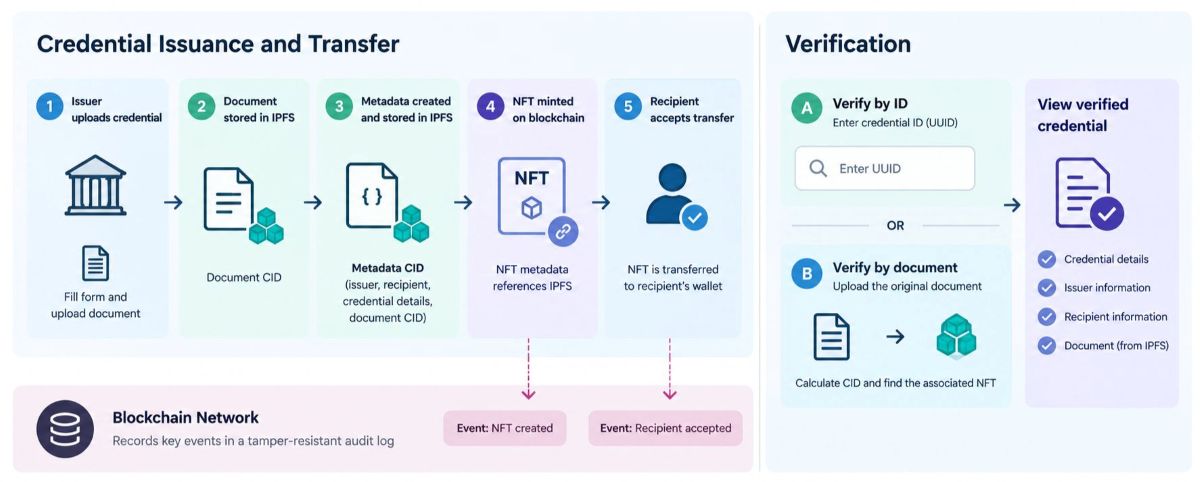
Figure 1. A layered credential workflow separating document content, metadata, immutable state, recipient acceptance, and verification.
Make Recipient Acceptance Explicit
At creation, the NFT initially remains in the issuer’s account. The intended recipient must accept the transfer before the token moves to the recipient’s account. That distinction matters because issuance and acceptance are different lifecycle events: a credential can be created before the recipient confirms possession of it.
The architecture also records important lifecycle events through Hedera Consensus Service. Events are written when the NFT is created and when the recipient confirms acceptance, providing an ordered audit trail alongside token ownership.
Verification Should Reconstruct the Credential
Verification can begin in two ways. If the verifier has the credential’s internal UUID, the system can locate the associated record directly. If the verifier only has the document, the file can be uploaded and its CID calculated. An altered file produces a different CID, so the uploaded content itself becomes part of the verification path.
Using the calculated CID, the system can locate the associated NFT, resolve its metadata reference, retrieve the credential metadata, and display the result. The objective is not to determine whether a certificate looks authentic. It is to determine whether the exact uploaded content can be connected back to the credential reference created at issuance.
What This Architecture Does – and Does Not – Prove
Content integrity is not the same as issuer trust. A CID can show that a file matches referenced content, but a verifier still needs confidence that the issuer is legitimate and authorized to issue that credential. NFT ownership likewise should not be treated as proof of every claim contained in the certificate; it is one observable state in a larger verification chain.
Privacy requires similar care. Keeping the certificate itself outside the ledger does not automatically make the system private. Metadata stored in IPFS may still be retrievable by anyone who obtains its CID, depending on system configuration and the information included. Data minimization, access controls, and careful metadata design remain necessary.
Real-World Testing Exposes Operational Gaps
Early deployments are useful because they expose problems that architecture diagrams often miss. Sotnykov’s D-Certify implementation has been used in limited hackathon workflows, including Iris Hacks IV and the Global Builders Hackathon, to issue verifiable credentials to selected participants or winners. These deployments remain small in scale, but they exercise the full lifecycle: issuer input, document storage, metadata creation, token minting, recipient acceptance, audit events, and later verification.
That end-to-end use highlights practical questions such as how to handle incorrect uploads, reissuance, unavailable IPFS content, compromised issuer access, revocation, and user confusion around token acceptance. In production systems, these operational details often matter as much as the ledger technology itself.
A Pattern That Extends Beyond Certificates
The broader lesson is not simply to “put credentials on a blockchain.” It is to build a chain of independently checkable references. Content addressing identifies the exact artifact. Structured metadata connects it to issuer and recipient information. An immutable state layer preserves the reference and ownership state. Separate event logs preserve important lifecycle actions.
The same separation of concerns can apply beyond certificates. Compliance records, software attestations, training credentials, and other digital artifacts may benefit from architectures in which integrity, metadata, ownership, and lifecycle history can be verified independently. The value comes from making state reproducible and boundaries explicit, not from using a ledger for every part of the system.
Lessons for Platform Teams
For platform and infrastructure teams, several design principles emerge. Large artifacts and durable state can live in different layers. Verification is stronger when it can be reproduced from the artifact a user actually possesses. State transitions such as issuance and acceptance should be explicit and observable. Audit logs and application state solve different problems and should not be treated as interchangeable.
Clear failure modes are equally important. A verifier should be able to distinguish between a CID that does not resolve, a document with no associated token, unavailable metadata, and a credential that has not yet been accepted. Trustworthy verification depends not only on proving success, but also on making failure understandable.
The post How Content-Addressed Storage and Blockchain Can Improve Digital Credential Verification appeared first on DataFLOQ.
