
All devices such as smartphones and wearables, home appliances, and industrial systems are linked to each other via mobile technology and the Internet of Things (IoT). Such a connected world becomes more intelligent and efficient but at the same time it raises new issues. The devices are interacting with several systems, and a minor failure may result in the stoppage of the system or loss of data. This is the reason why Quality Assurance (QA) is very important in maintaining flawless operation, security, and customer satisfaction.
The present write-up is about challenges, QA strategies for mobile and IoT ecosystems, and tools that determine the state of mobile and IoT testing.
Understanding the Complexity of Mobile and IoT QA
Mobile and IoT devices basically form a massive and interconnected network.
In fact, mobile apps act as the user interface for IoT devices, while IoT sensors capture real-time data and communicate it seamlessly to cloud platforms.
Such an intricate interconnection of software and hardware raises the question that testing of such a system is an extremely complicated task, which cannot be compared to the one of traditional software testing. Testers have to verify the hardware, software, connectivity, performance, and security aspects all simultaneously.
A small mobile app glitch can cause an IoT device to behave unexpectedly, and a weak network connection can disrupt communication between devices. Hence, QA in such systems has to be intelligent, uninterrupted, and driven by data.
Key Challenges in Mobile and IoT QA
Application testing in mobile and IoT environments feels like handling a complex network of the constantly changing parts. Quality assurance teams may very well be the most impacted by these kinds of issues:
Device Diversity
It’s estimated that there are thousands of different mobile devices, operating systems, firmware versions, and IoT sensors in use today. Testing every possible combination is practically impossible, which makes it extremely challenging to ensure that an application works perfectly across all devices, environments, and configurations without any glitches.
Network Variability
IoT and mobile apps are built to work on different types of networks such as Wi-Fi, Bluetooth, 4G, 5G and occasionally low-bandwidth links. QA teams should carry out their testing in various network scenarios in order to avoid situations where communications are delayed or connections get dropped.
Data Security and Privacy
The Internet of Things (IoT) gadgets gather a plethora of data about the users. Any weak point can expose sensitive information. Security testing must ensure proper encryption, secure APIs, and safe data transfers.
Real-Time Responsiveness
IoT applications often demand that changes be made in real-time, such as a smart thermostat that instantly changes the temperature. The QA teams have to ensure that the system is responsive, that there is no delay, and that the data is accurate, consistent, and securely transmitted across all connected devices and networks.
Scalability and Reliability
The system should handle large amounts of data and many user interactions, even when the number of connected devices doubles. QA testing should be able to determine if the system is performing under heavy loads and peak traffic hours efficiently.
Integration with Cloud and Mobile Systems
The majority of IoT devices use mobile apps and cloud databases for communication. One of the most challenging aspects of the QA process is the flawless integration and error-free data transfer.
Essential QA Strategies for Mobile and IoT Ecosystems
To beat these hurdles, companies must adopt well-planned QA programs that are tailored to mobile and IoT applications. The following are the main strategies that bring substantial changes:
Continuous Testing and Automation
Continuous testing makes sure that every update or change in the code is automatically checked. The use of automated tools diminishes the possibility of human error and is time efficient. It allows for the detection of errors at the early stages of the development cycle; thus, the overall product quality is enhanced.
Test on Real Devices
Emulators and simulators might be good tools; however, they are not capable of completely replicating the performance of the real world. Testing with actual mobile devices and IoT hardware gives more precise results.
Focus on Security Testing
Data safety should never be an afterthought. QA teams must run regular penetration tests, check for data leaks, and ensure that communication between devices and servers is properly encrypted.
Adopt AI-Powered QA
AI in mobile app testing helps analyze user behavior, predict failures, and detect bugs faster. AI tools can prioritize test cases, reduce redundant work, and deliver better test coverage in less time.
End-to-End Testing
A complete QA process must test the full system from the IoT device and mobile app to the backend cloud. End-to-end testing ensures all layers communicate and perform as expected.
Performance and Scalability Testing
Testing high traffic, heavy data loads, and extreme conditions ensures that the system won’t crash under pressure. Load testing and stress testing simulate real-world scenarios.
Agile and DevOps Approach
Combining QA with agile and DevOps methodologies enables faster feedback loops. It promotes collaboration among teams and supports continuous improvement.
Data-Driven QA
Modern QA is about finding bugs, however it is also about learning from data. Logs, user feedback, and performance reports analysis help to anticipate failures that will not be visible to users for a while.
Recommended Tools and Technologies
The proper use of tools can make QA efficient and effective. Here are some of the most useful tools for mobile and IoT testing that QA professionals might use:
- Appium: An open-source tool to automate the testing of mobile apps on Android and iOS.
- Katalon Studio: A user-friendly platform for testing automation of Web, API, and mobile.
- Postman: Great for API testing which is the base for the connection of IoT devices and cloud applications.
- Wireshark: Observes network communication and pinpoints problems in IoT data exchange.
- JMeter: An open-source tool for performance and load testing, especially useful for evaluating system behavior under heavy traffic.
- IoTIFY: A platform to simulate and test IoT environments and virtual devices.
When combined with professional QA services, these instruments become a great help to companies in making their systems more dependable.
The Real Value of Effective QA Strategies
Quality assurance (QA) strategies for mobile and IoT ecosystems that are effective entail more than just testing. Essentially, they revolve around trust. Consequently, when users experience a system that functions consistently, they become devoted to the brand.
Which means that companies by introducing well-organized QA practices will be able to:
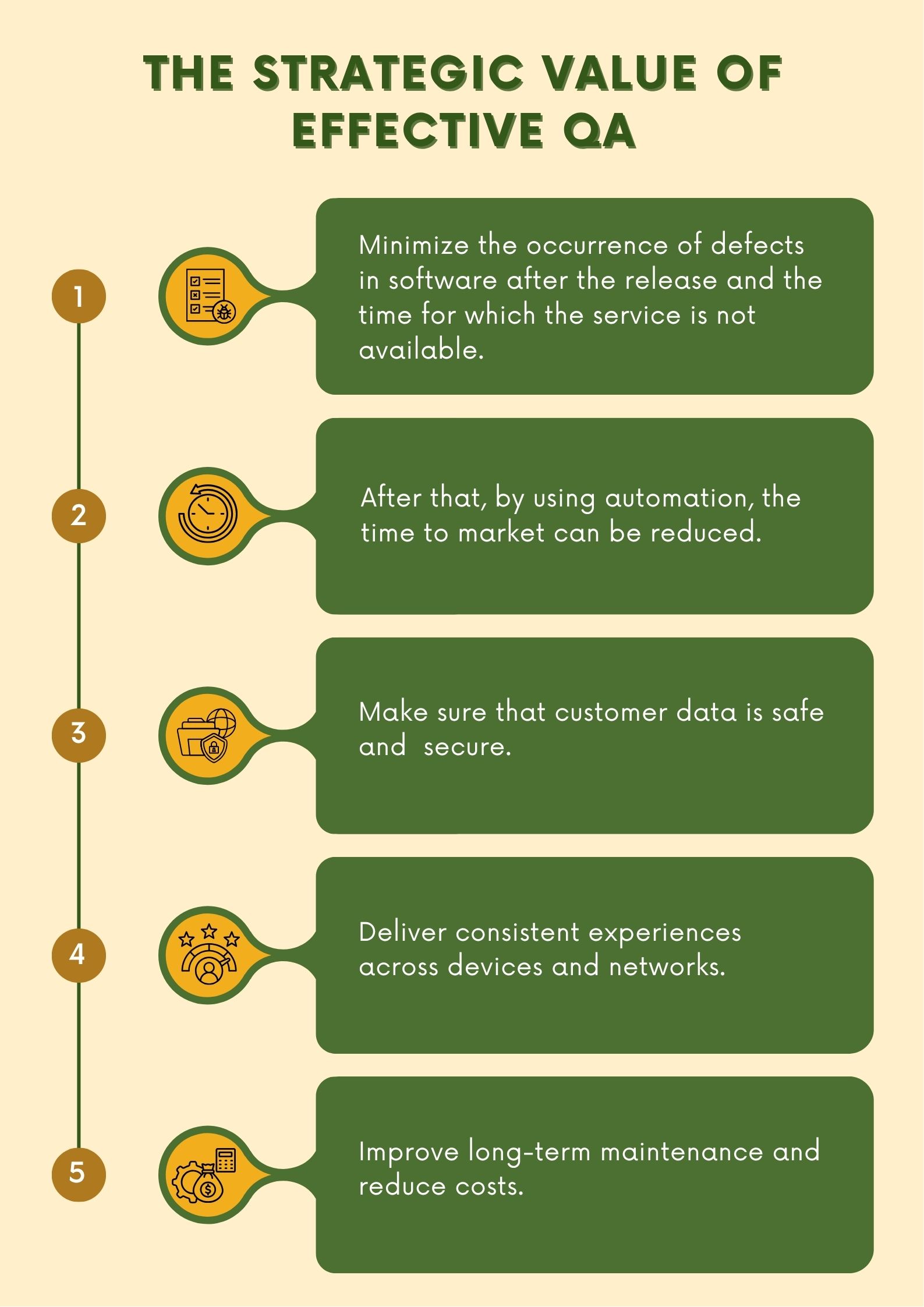
- Minimize the occurrence of defects in software after the release and the time for which the service is not available.
- After that, by using automation, the time to market can be reduced.
- Make sure that customer data is safe and secure.
- Deliver consistent experiences across devices and networks.
- Improve long-term maintenance and reduce costs.
Effective QA gives organizations a clear competitive edge. It transforms quality from an afterthought into a continuous process that drives innovation.
Conclusion
QA testing plays an essential role with the development of mobile and IoT ecosystems, which are growing more complex. Even one weak link in the system can influence every aspect of performance, including customer satisfaction and the company’s reputation.
Through the use of automation, AI, and proper QA tactics, enterprises can keep their apps working smoothly anywhere. Investing in mobile app testing and IoT testing services is a wise move for future success, stability, and trust.
Simply put, quality is the main factor that keeps the interconnected world viable.
Smart QA strategies bug-proof your software development and allow you to create better, quicker, and safer digital experiences. And in today’s interconnected world, that is what counts most.
The post QA Strategies for Mobile and IoT Ecosystems appeared first on Datafloq.
