
When people search for Data Engineer Salary in 2026, they are rarely looking for numbers alone. What they are attempting to comprehend is whether this position still justifies the time, effort, and specialization that it requires. Over the decade, data engineering has transformed the back-office technical role into an underlying layer of contemporary digital systems.
Nowadays, AI and real-time analytics, regulatory compliance, and mass personalization rely on sound data infrastructure. This has been the case as the economic value of data-driven system designers and maintainers increases with the reliance of the organization on these systems. It is a guide on how Data Engineer experience and expertise will be translated into compensation in 2026. Let’s get started.
Understanding What “Salary” Actually Includes
By 2026, Data Engineers will rarely be limited to fixed pay. Most of the offers include a variety of components:
- Base Salary: The guaranteed portion of compensation.
- Performance-Based Bonuses: The bonuses are correlated with individual or company performance.
- Equity/Long-term incentives: This is mostly found in product-based organizations.
- Retention or Signing Bonuses: These bonuses are applied when recruiting or retaining highly skilled personnel.
- Benefits: Health insurance, career advancement fund, and telecommuting.
Consequently, it is possible that two offers with the same headline number can have a very different value in the long term. It is necessary to assess overall compensation (not just the base salary).
The Role of Location in 2026 Compensation
The geographic location is another factor that affects compensation, but is not as effective as it was in past years. Companies are also making comparisons of salaries based on global market value, as opposed to domestic averages. Although the position in large technology centers may have a higher nominal salary, remote roles have reduced the difference, with exemplary pay being given based on the locality, with a slight adjustment to the cost of living.
For instance, as per the Indeed 2025 report:
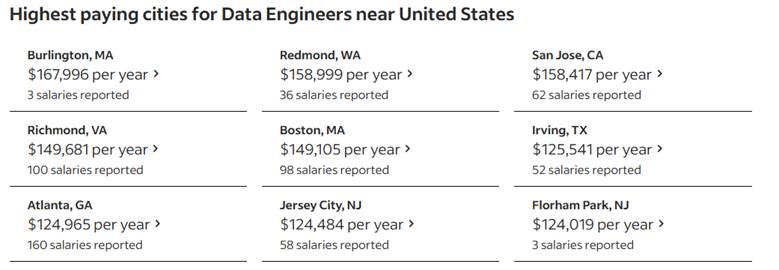
By this, you can understand that the Data Engineer salary in 2026 highly depends on geographical location. Those Data Engineers who deal with large-scale systems with high availability and reliability are paid more, irrespective of their location.
Top High Paying Industries
There are huge disparities in salaries amongst industries, and they are not arbitrary. Given below are the top industries that pay higher to Data Engineers in 2026:
- Technology & Software Product Companies
- Financial Services & Banking
- FinTech
- AI & Machine Learning Platforms
- E-commerce & Digital Marketplaces
- Healthcare & Biotech
- Insurance & Risk Management
- Cloud & Data Infrastructure Companies
- Telecommunications & Network Services
- Digital Media & Streaming Platforms
Skills That Have the Greatest Impact on Salary
In 2026, the factor of compensation is more related to technical depth than experience.
The areas of high-impact skills are:
- Distributed Data Processing: How to make systems scale.
- Cloud-Native Architecture: Management of data services and cost optimization.
- Data Warehousing: Optimization of modern analytical storage systems
- Streaming and Real-Time Pipelines: Enabling low-latency data applications.
- Data Governance and Reliability: Quality, lineage, and compliance.
Data Engineers capable of creating end-to-end system design and defining their application in business will always earn more than those specialized only in execution.
Demand for Data Engineers in 2026
The demand is good, but the expectations have changed. The use of automation and artificial intelligence systems has minimized manual pipeline maintenance. It has, however, put pressure on engineers to be in a position to design systems that can bring automation safely and effectively.
They are in search of Data Engineers who know how data is used to support machine learning, real-time analytics, and business-critical applications. This has seen demand move off the routine implementation work to system design and ownership.
Data Engineer Salary in 2026
A typical career progression looks like this, as per ZipRecruiter and Indeed 2025 salaries insights:
| Role | Experience | Compensation |
| Junior Data Engineer | 0-2 years | $71,799/year |
| Data Engineer | 3-5 years | $117,716/year |
| Senior Data Engineer | 5-8 years | $129,328/year |
| Lead / Staff Engineer | 8-10 years | $132,173/year |
| Data Architect | 10+ years | $153,185/year |
Promotion is not determined as much by titles but rather by the influence and extent of systems that have been owned and the decisions that are being made.
What the Next Few Years Look Like
Looking beyond 2026, several trends are clear:
- The use of AI will still be based on data engineering.
- Real-time analytics will be a mandatory requirement.
- Advanced data warehousing skills will continue to command premiums
- The demand will be the highest among engineers who will connect data engineering and AI systems.
Explore globally recognized data science certifications that can help you upgrade your career in data engineering and get the highest salary hikes in 2026.
Wrap Up
In 2026, data engineering is still a professional and financially viable profession, but not accidentally. Those who develop systems on which organizations rely to achieve stability, compliance, and growth are given high compensation. The market is no longer rewarded by shallow knowledge of tools, but by engineers who have an insight into scale, reliability, and business impact.
To individuals with the desire to develop deeper expertise, keep on track with the changing technology and make conscious career choices; data engineering remains of good long-term value, both in intellectual and financial terms.
Frequently Asked Questions
1. Does a Data Engineer’s salary grow faster than a Data Scientist’s salary?
Yes. In many organizations, Data Engineers salary growth outpaces Data Scientists’ due to infrastructure ownership and lower talent supply.
2. Is Data warehousing mandatory to become a high-paid Data Engineer?
At senior levels, yes. Data warehousing expertise is a core salary multiplier.
3. Can software engineers transition into Data Engineering for better pay?
Absolutely. A large proportion of high-paid Data Engineers are graduates of either backend or distributed systems.
4. Will automation reduce Data Engineer demand?
No. Automation will only help in performing repetitive tasks that do not require too much human intervention, but the demand for Data Engineers will keep increasing.
The post Data Engineer Salary in 2026: Global Pay, Skills & Career Outlook appeared first on Datafloq.
